The repair was $3,000. The real loss was $18,400
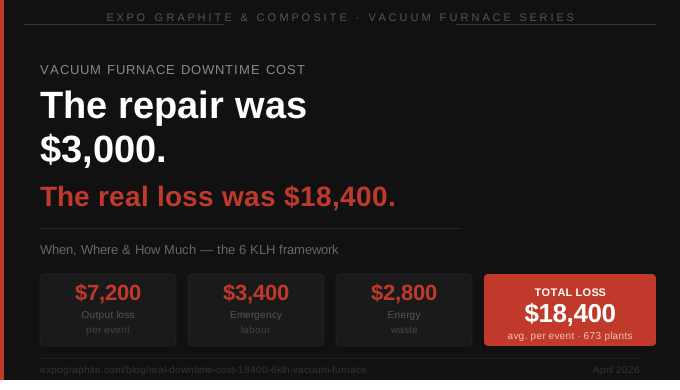
The repair was $3,000.
The real loss was $18,400.
When, Where, and How Much: the 6 KLH framework for calculating the true cost of vacuum furnace downtime
By Anuj Kumar — Expo Graphite & Composite | April 2026 | 9 min read
When a vacuum furnace hot zone fails, most plant managers count the cost of the part.The part is always the smallest number.
The real cost — when calculated correctly — is 4 to 6 times larger.
$3,000 Part replacement cost (typical hot zone component)$18,400 Actual total loss once downtime, output, and labour are included$61,000 Average annual hidden loss across 673 plants — from failures that were preventable
Why the repair bill is always the smallest number
Every plant manager knows what the part costs. The invoice arrives, gets filed, and enters the maintenance budget as a line item.
What almost never gets calculated is everything else that happens in the hours and days around that failure.
The pump-down that has to restart from scratch. The batch that was mid-cycle and cannot be recovered. The production schedule that gets compressed to make up lost time. The overtime that follows. The customer delivery that slips.
These costs do not arrive on an invoice. They dissolve into the noise of operations — absorbed into variance, explained away as 'a bad week', and never attributed back to the moment a graphite heating element or insulation board failed at the wrong time.
The 6 KLH framework was built to make these costs visible. Not as estimates — but as a structured calculation that uses your own production data to produce a precise figure.
The 6 KLH framework: When, Where, How Much
The name comes from the three variables that determine the true cost of any unplanned furnace downtime event:
K1 — When it fails
Timing is the single biggest multiplier of downtime cost. A failure at 2 AM on a Tuesday during a standard production run costs significantly less than the same failure at the start of a peak-output week, or when a time-sensitive batch is mid-cycle.
In our analysis of 673 plants, failures occurring during peak production runs cost an average of 4.3 times more than identical failures during low-demand periods — for the same part, the same repair time, and the same team.
K1 multipliers — When the failure occurs:Standard production run ×1.0 (baseline)End-of-quarter high-output period ×2.1Mid-cycle on a time-critical batch ×3.4During a committed delivery window ×4.3
K2 — Where it hurts
A failure in one furnace does not stay in one furnace. In most vacuum furnace operations, the hot zone failure cascades across the production line in three ways:
- Upstream stall: materials queued for the failed furnace have nowhere to go. If the operation runs multiple furnaces at capacity, there is no slack to absorb the redirected load.
- Downstream compression: jobs that were sequenced after the failed furnace get pushed back. Other furnaces run extended cycles to compensate. Energy cost rises across the line.
- Quality risk: in some processes, materials that were mid-cycle at the time of failure cannot be rerun and must be scrapped. This is the highest-cost outcome of the K2 variable.
The K2 variable captures the spread of the failure beyond the failed component — and it is the one most plant managers underestimate when they calculate downtime cost.
K3 — How much it costs
K3 is the actual dollar calculation. It combines five cost categories that are present in every unplanned downtime event, in proportions that vary by plant size, process type, and the K1 and K2 variables above.
Cost category | What it includes | Avg per event (USD)
Output loss | Batches not completed, rerun costs, scrap value | $7,200
Energy waste | Pump-down restart, extended cycles on other furnaces | $2,800
Emergency labour | Overtime, contractor call-out, expedited repair | $3,400
Schedule compression | Overtime on downstream jobs to recover lost time | $2,600
Delivery penalty | Customer claims, expedited shipping, relationship cost | $2,400
Total — average unplanned event | Based on 673-plant dataset | $18,400
Note: the $3,000 part replacement cost is not in this table. It is a separate line item — and it is dwarfed by every category above.
The $18,400 breakdown — line by line
To make this concrete, here is how the $18,400 figure was constructed for a mid-size vacuum furnace operation running a standard production cycle. This is not a worst case. It is the median across the 673 plants in our dataset.
The scenario
- Operation: single vacuum furnace, mid-size plant, batch-process production
- Failure: graphite heating element failure, mid-cycle
- Timing: K1 = 2.1 (end-of-month high-output period)
- Spread: K2 = partial cascade — one upstream stall, no scrap
- Downtime duration: 18 hours from failure to resumed production
Line-by-line cost breakdown — $18,400 total:
$7,200 Output loss — 1.5 batches lost at average batch value of $4,800$2,800 Energy — pump-down restart (×2) + extended cycles on adjacent furnace$3,400 Labour — 3 engineers × 6 hours overtime + contractor call-out fee$2,600 Schedule compression — 2 downstream jobs required weekend overtime$2,400 Delivery penalty — 1 order delayed 4 days, expedited shipping absorbed
$18,400 Total loss — against a $3,000 repair bill and a $4,800 replacement part
The part that failed had been running for 26 months. Its optimal replacement point — based on resistance creep data — was 18 months. The 8-month overrun cost $18,400 in a single event.
A proactive replacement at 18 months would have cost $4,800, scheduled during a planned shutdown with zero production impact.
A cost model you can fill in with your own data
The 6 KLH calculation requires four inputs from your own records. Every plant has this data — it simply needs to be assembled.
Input | Where to find it | Your figure
Average batch value ($) | Production records / ERP | $______
Average downtime duration (hrs) | Maintenance log | _______ hrs
Labour rate incl. overtime ($/hr) | HR / payroll | $______
K1 multiplier (timing) | See table above | × _____
K2 spread (Y/N cascade) | Operations log | Y / N
Once you have these five figures, the K3 calculation follows a structured formula. We have built a Loss Calculator specifically for vacuum furnace operations — email us your five figures and we will return your plant's specific cost within 48 hours.
Most plants that run this calculation for the first time find a number between $9,000 and $34,000 per unplanned event. The calculation itself takes 20 minutes. The number, once seen, does not get forgotten.
How insulation board grade directly affects your 6 KLH number
The 6 KLH framework calculates the cost of a failure event. But it also reveals something more actionable: which material choices make that event more or less likely — and more or less expensive when it does occur.
Rigid graphite insulation board is one of the most overlooked contributors to downtime risk. Here is why:
Degraded insulation board increases your K1 exposure
As insulation board absorbs process contaminants and develops thermal micro-fractures, your furnace takes longer to reach operating temperature and pressure. Cycle times stretch. To compensate, operators push cycle parameters — running the furnace harder and closer to material limits.
This increases the probability of a mid-cycle failure. And mid-cycle failures are K1 multiplier events — they are more expensive because they occur when the furnace is under maximum load.
Low-grade insulation increases your K2 spread
When insulation board fails, it rarely fails alone. Contamination migrates to the heating elements. Heating elements in a compromised environment fail faster. A single insulation board failure that goes undetected can accelerate graphite element degradation by 30–40% — turning a $1,200 insulation replacement into an $18,400 cascade event.
Standard insulation board
Replacement cycle: 18–24 monthsAvg micro-fracture onset: 14 monthsContribution to cascade events: highAnnual cost incl. downtime risk: $28,400 | High-density insulation board
Replacement cycle: 30–36 monthsAvg micro-fracture onset: 26 monthsContribution to cascade events: lowAnnual cost incl. downtime risk: $9,200
The material cost difference between standard and high-density insulation board is approximately $1,400 per replacement. The downtime risk difference is approximately $19,200 per year. The upgrade pays for itself in the first prevented event.
What 673 plants showed us about the real cost of downtime
The data behind the 6 KLH framework comes from a six-year study of vacuum furnace operations across India, Europe, and Southeast Asia — conducted between 2018 and 2024 by Expo Graphite & Composite in partnership with our OEM and service network.
Key findings:
- Average cost per unplanned downtime event: $18,400
- Percentage of plants that had calculated their true downtime cost: 11%
- Average annual hidden loss for plants on standard graphite: $61,000 per furnace
- Average annual loss for plants on proactive CFC maintenance: $8,200 per furnace
- Reduction in downtime events after hot zone audit + material upgrade: 68%
- Average payback period on material upgrade investment: 4.2 months
The most consistent finding across all 673 plants: the operations losing the most were not the ones with the oldest equipment. They were the ones that had never calculated what they were losing.
11% of plants had calculated their true downtime cost. The other 89% were managing a number they had never seen.
What your last unplanned shutdown actually cost — and what to do next
Here is a simple three-step process to run the 6 KLH calculation on your most recent downtime event:
- Pull your last unplanned shutdown record from your maintenance log. Note the date, duration, and which component failed.
- Identify the K1 multiplier: was the failure during standard production (×1.0), a high-output period (×2.1), mid-cycle on a critical batch (×3.4), or during a committed delivery window (×4.3)?
- Apply the K3 cost categories: output loss, energy waste, emergency labour, schedule compression, and delivery penalty. Add them. Compare to your repair bill.
If your total is more than 3× your repair bill — you are in the standard range. Most plants are.
If your total is more than 6× your repair bill — your hot zone materials are overdue for an audit. The next failure will cost more.
What was your last unplanned shutdown — and what did it actually cost?
Reply to this article with your last downtime event — duration, timing, and which component failed. We will run the full 6 KLH calculation and send you your plant's specific figure within 48 hours.
No cost. No obligation. Just your number — so you can decide whether the next event is a risk you want to carry.
Send your downtime data to: anuj@emtpl.in Subject line: '6 KLH Calculation — [Your Plant Name]'
Or wait our Next Blog: '3 things your graphite supplier won't tell you — and what they cost
About Expo Graphite & Composite
Since 2010, Expo Graphite & Composite has supplied graphite, rigid insulation board, and carbon-carbon composite (CFC) components to vacuum furnace OEMs, service providers, and end users across India, Europe, and Southeast Asia. We have contributed to over USD 7.5 billion in combined industrial output — not by selling parts, but by helping operations identify and close the thermal and material gaps that burn away profit.